
Introduction
My name is Liam Casey and I’m a pretty avid social media user. I spend a lot of my time on Twitter or checking out sweet memes on Instagram; really any time that I am bored I find myself checking some form of social media. I worked as a Media and Sponsorship Intern for Live Nation Entertainment, and we had to monitor our sponsors’ social media pages as well as the Live Nation pages. As much as I use social media, though, I have never taken a class on the subject. I’ve taken a few classes that touch on social media and how they can be used in professional fields, but it has always just been a topic that we’ve touched on. That being said, I am excited to see what I take away from this class because social media is ubiquitous now– it seems like every person and every business has a presence on social media in some way.
I’m really interested in seeing specifically how different businesses use social media in different way in order to promote their services or products. I used social media a lot in the internship I had last year for a start up SEO/Website Development company and most of what I was doing was trying to build a following in order to have a base to which we could market our service. I am more interested now in seeing how businesses that already have a solid following use social media to promote their brand, and how social media can be a viable, successful marketing tool.
Midterm Reflection
Throughout the semester my views on social media and the way that it can be used professionally– whether that be through marketing/advertising, or using it to your advantage to build a personal brand– have drastically changed. I have learned about using social media as a marketing/personal branding tool in many other classes, but in this course I think that there is more detail given on how I can specifically use social media rather than solely observing/learning the ways that business use social media. I’ve really been interested in the ways that businesses use their social media to interact with their users and the language that they use when posting, commenting on a positive post, or remedying negative situations.
I feel like I’ve learned the most through my research for my process doc because I’ve had to look into several businesses, as well as my own, and learned the ways in which they use their social media. I don’t think having a set group is really the best way to do this work because I think that the only truly helpful part of the group work is seeing other people’s views of social media and other things that they are learning with their brands that I may not be. I just think seeing/hearing as many viewpoints as possible is the most efficient way for us to learn about this subject in groups.
I think this course really connects with other classes that I’ve taken. As a Media and Professional Communications major with a certificate in Digital Media, I have taken more classes about media than I can count and each of those classes have incorporated social media in some way. This class just really breaks down the different uses of social media that I have learned about.
I think that the most helpful part of this course so far has been the process document, but I do think that it’s just a lot of writing and reading in a short time. We had 5 assignments due in a row and I’ve been kind of overwhelmed with that writing. I think if the assignments were due at midnight on Wednesdays, and if most assignments were due Wednesday it would have helped me stay more organized with my work. I don’t think it was too much writing necessarily (because this is a writing course) but it’s been confusing knowing what is due and when they are due. Other than that I have no complaints!
Final Reflection
Wow, I can’t believe it’s almost over. Throughout this semester, I’ve put a lot of work into this website portfolio. Here you can find information about me– my social media tendencies, and a link to my LinkedIn profile so that you can learn more about me as a professional. I’ve also worked a lot on the Process Document, in which I analyze the social media strategy of Responsival, an up and coming Website/SEO Company that I worked for my Junior Year. I have also created a potential strategy that I believe can enhance Responsival’s social media presence. I’m really proud of that strategy because it was something that I was working on a bit with Responsival, but I now have a concrete plan of action that I can show to them. I’ve also created a story about the Philadelphia Eagle’s historic Super Bowl run this past season, as well as an Op Ed about the concept of the filter bubble in social media.
I’m really excited about the Process Document and strategy for Responsival. I have a lot of respect for the guys that work there and the extremely hard work that they put in every day to build the company. In just three years they have grown exponentially, and I’m hoping that this strategy can help take some of the strain off of focusing on their social media, so that they can continue to grow their business.
What’s next for me? God knows. I am planning on moving to Denver to work in content marketing or as an encode technician working with metadata and short form content for a television company (that I do not wish to name because I really don’t want to jinx it.. “I’m not superstitious, but I am a little stitious”).
Thanks so much for a great semester Sarah! I really did learn a lot about the practical uses of social media for businesses and building my own personal brand.
About Me
Hey Guys! My name is Liam Casey and I'm a senior at the University of Pittsburgh studying Media and Professional Communications with a focus in Corporate Relations. I am also getting a certificate in Digital Media. I'm from Philadelphia, Pa. (15 minutes away from center city unlike some Pitt kids, who think anything inside Reading counts as Philly). I'm really excited for a great semester and to learn about the professional uses of social media for businesses and building a personal brand!
Social Media Audit
My partner for the social media audit was Maura. This is what she found, when looking at my social accounts:
Step 1
-
Google your partner’s name. What have you found?
-
I see a twitter account for Liam Casey, the CEO of PCH International. I also see a LinkedIn account for the same Liam Casey, as well as a cruchbase profile and an article about him by Fortune.com. There is also a side panel featuring an Irish soccer player named Liam Casey.
-
-
Is your partner on LinkedIn? Facebook? Twitter? Other social platforms?
-
Yes, he is on LinkedIn, Facebook, Twitter, Instagram, and Snapchat. I can’t easily find this on Google, but I know this because we follow each other on all of these platforms.
-
-
Describe your partner’s behavior on social media. Is your partner active or passive? What types of content does your partner post?
-
Yes, Liam is really active on Twitter and tweets original content often, as well as Re-Tweeting a lot. Most of this content pertains to sports and humor. On Instagram, Liam is active, but less so than Twitter. His Instagram is circulated around posts with friends and family; I can see too that he went abroad because there were a series of posts ranging from August to December of him in various countries. His captions are usually witty and pretty funny. His Facebook is very passive, the only posts that I see are either him being tagged in photos or updating his profile picture/cover photo.
-
Step 2
My overall perception of Liam is that he’s fun loving and likes to post things with the intention of making people laugh. His captions are usually rooted in some form of play on words, or making funny references that relate to his pictures.
Step 3
To enhance the strategy, Liam could focus on posting more content on Facebook, as most of his content is posted by other people that tag him in photos. He could post more pictures of his time abroad, for example. He could also try to post some more serious content so that people looking at his profiles know that he’s not all about being funny.
Step 4
Maura’s audit of my social media accounts are pretty on point. I really use my Twitter to post content that I think other people would look at and think are funny. I see social media as more of an escape from reality– a place to go to have fun and relax– but I could definitely try to be more serious in some of my posts. She also hit the nail on the head with Instagram; I really like posting pictures of myself with other people, I think I only have 3 posts with just myself in it. I do like her suggestion of posting more on my Facebook, especially with photos of my time abroad as I think this would allow potential employers see what I’ve been up to rather than just posts of me with family or at parties.
Reflection
Finally, include your description of your own brand personality (and differentiate between "in person" and "on social media," if they are differentiated/use any other sort of differentiations as necessary (for example, by platform)
-
I would describe my brand personality as funny and laid back. As I said, I like using social media as an escape from the real world, but I do keep my social media self intertwined with my real personality. I love making people laugh, so I focus my Tweets and Instagram captions on being humorous. That being said, every time I post I do think about potential employers or other adults (like my parents friends) seeing my posts. I want to keep my voice the same, but I alsow want to be appropriate and respectful. I would say my posts are wholesomely funny with mostly observational humor or referencing movies and TV shows. All of my platforms are private because I do not like the idea of people that I do not know following my accounts and I am not actively looking to work in Social Media, so I do not think it’s important to have my accounts public.
Visitor/Resident Map

LinkedIn Profile

Click image for link to LinkedIn Page
Creating a Responsive Internet
A Social Media Strategy for Responsival

In today's society, every business needs a website to connect with potential clients. The growing importance of the digital media landscape in the world of branding an marketing will allow us to create a farther reach for potential clients while staying true to our loyal customers and our brand.
To create a viable social media platform from which we can reach more potential customers and continue to advocate for our current clientele I am creating a social media strategy for Responsvial. Through our Facebook and Instagram pages, we will create two unique platforms that will allow people to more clearly understand Responsival's brand, while also giving a personality to our business. This will allow us to connect with more small business owners in the Pittsburgh area and beyond to father continue the success of our business without losing the foundational characteristics that make up the Responsival brand.
Strategy
Process Doc
I would like to create a campaign for Repsonsival, the company that I interviewed. I used to work for this start up and I implemented the beginning of our social media platform as we started getting off the ground. Responsival works in developing responsive websites which means that the sites respond to the different interfaces– desktop, tablet, phone– that a consumer may be using to view a website. Since this company works closely with technology, and their business is built through online interaction, they should have a stronger presence in social media.
I talked to Eddie, the marketing and social media coordinator for Responsival, and he explained to me that their social media presence has grown since I’ve left the company, but not by much. He tries to post at least twice a week and most of the posts only revolve around businesses whose sites they have launched.
I really believe that having a strong social media presence in the Pittsburgh area would help Responsival generate even more business than they already are. Eddie told me that most of their posts are geared toward the Pittsburgh area because they generate more likes and interactions with the posts and websites themselves. For this reason, I think that Responsival should be utilizing their social media to connect with more businesses in the area in order to gain an even larger, and potentially more successful following.
The interview with Eddie really did inform my decision to create a strategy for Responsival. The more that he explained the social media strategy of Responsival as a viable revenue generator, the more I realized that not much had changed since I left. I would ultimately like to create a sound strategy that I could potentially present to Responsival and my old boss to show them how much a strong social media presence would help them generate new sources of business.
Brand Analysis
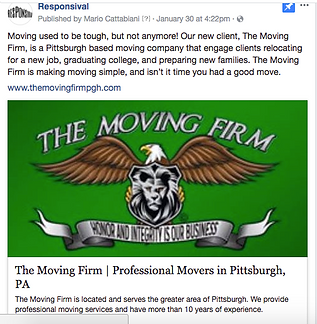
Responsival is an up and coming tech start up in Pittsburgh. The idea of their product is to basically integrate SEO and web design to give customers the most up to date websites on the market for the cheapest price. They reflect their business model and their brand through their social media in a few ways. They are only on Facebook and Instagram because they believe that tweeting would take too much time away from their focus of business-to-business marketing. They mostly focus their content on promoting businesses that they have just launched a website for. Most of their posts look like this:
They post these images and links about twice per week in order to keep up with new businesses joining the “Responsival Family”, as well as promoting the businesses if they have any special promotions or one time offers that are happening. They also enjoy posting about businesses that are being active in the community. This choice in content shows that Responsival really wants the businesses that choose them to feel like they are becoming a part of a family. It’s a really important aspect of their business because changing website providers for some businesses can be the difference between surviving, thriving, and closing down. If they give their primary marketing aspect (their website) to a designer that doesn’t care about them and just wants money there’s a good chance that they could be taken for a ride, lose a lot of money, and potentially lose their website all together. For this reason Responsival wants to portray the feeling of being part of a team or family to potential clients.
The language in these posts is also really relaxed. In today’s business world, tech is a young man’s game, so it’s important that their brand remains professional while also staying a little less formal in their word choices. They want to promote their brand, and their clients’ brands in a way that relates to both parties. If there is a website for workout equipment, the wording may be a bit more lively or energetic than one for, let’s say, a doctor’s office.
Mostly, for images, Responsival uses their client’s logo or image. This is because most of their posts are about promoting a company or getting the word out about something one of their clients is doing. They do sometimes throw some pictures on Instagram of the office life or some profiles of employees in order to give potential clients a little glimpse of who they’ll be working with and to show them that this business is really geared toward them; it’s not a huge corporate developing these sites, it’s just some nice people that love what they do.
Competitor Analysis
There are really too many competitors out there that deal with web design and SEO to choose one to analyze, but the main goal of Responsival is to grow big enough and compile enough data that they become a site that allows people and businesses to create their own SEO compatible website. The main competitor would be Webflow, which is the system that they use now to design their sites. It’s a great tool because it allows you to design the site from a more template format, while also being able to mess around with the HTML code in order to optimize the site’s search engine ranks. This is why Responsival uses Webflow exclusively. However, while designing these sites and managing existing accounts is financially productive for Responsival, they see more money in the template space.
Web flow does not really have any social media that they utilize their social media for business-to-business interactions, but rather to promote their new site aspects and tools that people can use to make their sites great. Ultimately, I believe Responsival will have a similar social media presence as Webflow, but I really think that they will continue to design sites as a “premium” feature and promote those sites as they have been doing this whole time.
Webflow also uses far more formal language, which I would understand because they are a larger company and they are directing themselves at professionals, but I think that Responsival would lose a special aspect of their brand if they went as formal as Webflow. Their brand is more youthful and fun as if making a website that rocks is a fun time. I don’t think they will stray away from this aspect of their brand. Overall, I think that Responsival will use different aspects of Webflow’s social media strategy, but their voice and tone will remain the same.
Content Examples


I thought that these examples were pretty good for showcasing some good posts by Responsival over the past month or so. The first picture on the top left is not a typical post from Responsival. It highlights the importance of responsive technology for SEO purposes, and plays as more of a call to action for a follower to use their product or to look into responsive technology more. I thought this was a good example of content because they are targeting both potential consumers that follow them, as well as reinforce their importance to their current clients. The second picture (top right) is another good example of content from Responsival. It is, again, not their typical site launch post, but it highlights their client Kanayo who recently dropped an album. This is one of the things that Responsival does so well, they keep up with their clients and try to post about how well they are doing. They are not only promoting their business, but also their clients. They are using their social media to reinforce their business with both their clients and potential customers. The last image is a more typical post from Responsival. They focus on promoting one of their clients during a busy time of the year. While I could not find a recent post of them promoting a website launch, I do think that this post also embodies the typical online presence of Responsival. They focus all of the content on promoting the business in hopes that users will click on their hyperlink and check out the site. The really interesting part of this strategy is that by promoting their clients, they are in turn promoting themselves because if users click on their site then that’s a win for Responsival. They want to drive as much traffic as possible to their clients sites because while it is definitely good for the client, it really helps them promote their services as well.
Audience Analysis
Responsival’s following on social media is not very big, so the sample size of their audience is quite limited. This is the reason that I want to work with Responsival, so it’s not the worst thing in the world that their presence on social media isn’t huge. Their audience is mostly younger adult men raging from the age of 18-34 living in Pittsburgh, Pa. About 66% of their users are males in that age range, while the 34% of women tend to be closer to the 24-34 age demographic. These users are not necessarily intensely using social media, but from what I’ve seen most of them use their social media to connect with local businesses. Responsival’s posts do not have a lot of interaction, but they normally reach about 50 people.
I believe that Responsival’s primary audience is business owners in the Pittsburgh area that use social media to gain information about, and follow, other businesses. This is perfect for my target audience because I want to start connecting with business owners through social media to help drive business for Responsival. While it would be ideal to target people who are active on social media, I am seeing this as more of a networking and referral tool for the business. The main objective would be connecting and creating a relationship with these business owners, or their business in general. The secondary audience would be to target the users of those businesses. I am hoping that once Responsival connects with these businesses, they will post a link to their new site, which will open an entirely new door to potential clients. For a tertiary audience, I would hope to connect with people who are not related to any business, but may know someone who is in need of Responsival’s services. Basically, I want to work through the layers of social media from the clients themselves, to the related followers of the clients, to other individuals that are not necessarily related to any business, but may create buzz about Responsival.
Social Media Policy
Rules and Regulations
-
Brand Guidelines
-
Have a positive message about the brand we are representing. Have a selling point for each the brand involved to show why we are working with them.
-
If you are posting about Responsival in any way, the same rules apply as well.
Etiquette and Engagement
-
Positive Engagement
-
Favorite/Like the comment before responding.
-
Keep the message concise if you are commenting back to someone.
-
If you need to write a message longer than 50 words, you should direct message the person to whom you are commenting.
-
Keep responses professional (no exclamation points, or emojis).
-
-
Negative Engagement
-
Always handle negative comments with direct message.
-
Make sure to specifically address the reason for the person’s discontent.
-
Try to offer a way to remedy the situation (make sure it is approved by Bryan. it before something to client)
-
-
Confidentiality
-
No passwords or account information should EVER be shared in any way via social media.
-
Never post about an upcoming project before the pay order is sent and Bryan approves it.
-
Once a deal is complete, discussing an upcoming project is completely acceptable to promote our client’s brand.
-
Roles and Responsibilities
The following roles and responsibilities are to be completed by the acting Social Media Coordinator of Responsival Inc.:
-
Engaging customers via social media platforms.
-
Customer Service via social media platforms.
-
Responsival Promotion via social media platforms (new clients, launched sites, updates, as well as anything our clients may ask us to post about)
Potential Legal Risks
-
Credit Sources
-
If you are posting a photo/sharing something that is from a client’s social media page, make sure to tag to ensure that you credit them as your source.
-
-
Privacy and Disclosure Procedures
-
Confidential material includes client account information, passwords, and information about unfinished projects that has not been approved by Bryan.
-
Security Risks
-
Passwords
-
Keep different passwords on all social media platforms.
-
Change every change every 6 months.
-
Accountability
-
It is important that employees know that they are always representing the Responsival brand, even if they are not in the office.
-
All personal accounts are exactly that, personal accounts. We want you to be yourself with your personal social media, but remain professional.
-
Be respectful.
-
Don’t not post anything that you would be embarrassed for your mother to see.
-
Style Guide
Principles
-
Aim to promote Responsival or our client’s in a positive light.
-
Do not aim to alienate anyone regardless of what is said online.
-
Keep the Responsival brand in mind with every post.
-
Less is more.
Voice and Tone
-
Write your posts in your own voice, but understand you are representing Responsival at all times.
-
Short and concise answers are always better.
-
We want to have a light tone, but remember to keep messages professional.
-
Make sure to address whomever you are interacting with in a post.
-
If you are commenting back to someone, use the person’s name.
-
If you are posting about a client or product launch, address it directly.
-
Content Types
-
Facebook Posts
-
Purpose: to get the word out about our clients and our new site launches. We want to engage our audience to check out our new client by looking at the new website. This is how we will generate more buzz about our design abilities.
-
Readers: Followers of both Responsival’s page and the client’s page.
-
Average Length: 100-200 words
-
-
Instagram Posts
-
Purpose: To promote the Responsival brand and our client’s brand more intimately to customers. The voice of these posts is more elaxed and focuses more on the daily grind at Responsival to give our brand a face and personality, while also promoting our new clients and giving them more personal shout outs. We believe this is the best way we can market to businesses and create relationships with potential clients.
-
Readers: Followers of Responsival and Client's pages. More specifically geared toward potential clients.
-
Average Length: 50-100 words
-
Grammar and Usage
-
Always capitalize any letter that begins a sentence, and any proper nouns.
-
ALWAYS remember to capitalize Responsival and our clients’ names.
-
Use punctuation to end every sentence.
-
Avoid exclamation points.
-
-
Avoid using abbreviations, and always spell check before posting.
-
Don’t write out numbers, use their numerical form (1,2,3…)
-
Web Style
-
Make sure to address our client’s name in the first sentence of each promotional post.
-
Italicize emphasized words.
-
Keywords: responsive, SEO, design functionality
Goals, Objectives, Alignment
The two biggest goals that we have set for Responsival’s Social Media Campaign are creating brand awareness for Responsival and our clients, as well as driving traffic to our client’s websites and our social media pages.
Goal: Creating Brand Awareness
-
Target: Generate over 2000 total social media interactions with potential/current customers by April 15.
-
Strategy: Use current followers on Facebook and Instagram to increase
-
Tactics:
-
We will track the growth of our following throughout the campaign to determine how successful our plan is.
-
- Metrics:
-
We can track this KPI by analyzing the amount of clicks that we are getting on each post as well as likes and comments.
-
-
-
Goal: Increase Number of Clients
-
Target: Generate 5 new clients through social media by April 30.
-
Strategy: Actively have our existing clients promote Responsival as updates, or new sites come out in order to get the Responsival name out (this also helps with creating brand awareness) as well as showcase our sites.
-
Tactics:
-
In order to drive traffic for both us and our clients, we will analyze our social media and website data to see how many people clicked on our client’s page, or our page, through social media, or any other means. We can do this with Google Analytics, or Webflow Analytics.
-
-
Metrics:
-
We will track the growth of our following throughout the campaign to determine how successful our plan is.
-
-
This aligns with our non-social-media goals because we are always trying to promote our brand and our client’s brands as well as drive traffic to the sites that we create.
Strategy Distribution Plan
For my strategy distribution plan, I will be using Instagram and Facebook as my primary platforms on which I will launch our social media campaign. Our Facebook page will primarily be used to promote our clients’ businesses through their new websites. While we will also be posting information about the practical necessity of having a responsive website and promoting Responsival, most of our content will surround our clients and their new sites. On Instagram, we will focus more on giving our brand a personality. By this, I mean that we will post about things going on in our office, and profiles of designers and account managers. Since websites have become an incredibly important aspect of businesses, and many people are trying to tell businesses websites, we want to separate ourselves from the competition. By putting faces to the names of the people who will be working on these accounts, I think that businesses will be more comfortable letting us design their website.
We will primarily use shared and organic media assets in order to promote Responsival. Our links to the websites, and sharing our clients’ posts about us will be the best ways that I can think of to promote this business. Clients are constantly sharing links to their websites, so by sharing these posts, we are both promoting our client and Responsival.
Our social media will be completely centralized because the social media was made from the ground up (genesis model). All of the messages and content posted will come through the Responsival Social Media Coordinator.
Content Examples

This is a great example of how Responsival will post about their clients in order to promote both the Responsival brand as well as promoting our clients. There's a quick little intro that is relevant to the current time (Happy New Year). It then proposes a generic question for people to relate to, but that also relates to the business that we are promoting. Finally, we will throw in a quick little "check out this website" so that people might click on the link and check out our work. We want to subliminally make people think "WOW what a website!"


These other two examples are great pieces that exemplify what we want to do on Instagram. Since we have clients’ businesses on Facebook, we really want to make Instagram a different sort of entity for our social media plan. I want to give people a look into who Responsival is as a company, giving people an inside look into our employees and the people who are actually working on these sites. From my experience, clients are really worried about working with big corporate companies to run their sites because it’s too impersonal. Since we are constantly in contact with companies, we want them to know who we are and give them a face to the names that they are dealing with every day. Ultimately, the goal of this is to have people see us as more of a separate company, but rather an extension of their own business that has people working for them that they can relate to.
Measurement
In order to measure the success or failure of this social media plan, I will look at the advanced metrics on Instagram and Facebook, as well as more obvious metrics like likes and comments on the posts.
On Facebook, for each post I will look at the number of comments, as well as the content of the comments. We rarely get negative feedback on posts, but it does happen. If this were to happen we would take measures to rectify the situation privately. As well as comments, I want to look at the amount of likes/reactions on each post. Normally, posts range from 10-20 likes/reactions. Ultimately I would like this number to double. I will also look into the advanced metrics of the posts such as total engagements with the post and links that are attached. Even if people aren’t liking posts, the goal is to get them to look at the client’s website in order to promote both our business and theirs.
On instagram most of our analytics will come from looking at likes and comments rather than advanced analytics. While we could use third party analytic applications, I think that the goal of our Instagram differs greatly from the purpose of Facebook. Our Instagram posts usually receive 40-60 likes, so we want that number to be closer to 60 than 40. As for comments, this will work similarly to Facebook. We normally get about 5 comments per post and they are all normally positive, but we would like to see that number rise. Overall, I believe that the metrics of Instagram are far less important than that of Facebook for business value because we are using it as more of a “personal” platform for our business.
As for revenue, we would ultimately like to see the number of followers rise on both platforms. We can do this by telling our clients to like our page and share our posts about their businesses. Hopefully, by driving our clients to share our posts we can reach a far larger audience and see our metrics in all categories rise.
Rationale
Throughout this semester, most of the texts that we have read have all touched on one incredibly important topic: tone and voice. While I did know that the tone of the posts and content were important in social media, I never really thought of the practical importance of having a consistent tone and voice. In Ann Handley’s Everybody Writes, Fenton and Lee’s Nicely Said: Writing for the Web with Style and Purpose, and Handley Chapman’s Content Rules each of author discusses the importance of tone and voice in creating a relationship with the audience. This is particularly important for me because I want to turn Responsival’s social media from strictly content promotion to creating a brand around which they can more successfully market themselves.
In an article from Entrepreneur.com titled “The 4 Essentials to Building Your Brand on Social Media”, the author, Aaron Agius, says, “you’ll create a much stronger brand reputation if you focus on creating useful content that viewers will want to share, rather than cranking out content to meet arbitrary publishing calendars.” In the beginning I wanted to solely use Responsival’s pages to publish a lot more content rather than more meaningful content. However, the more I began to focus on the tone and message of the content and how it would relate to/create a viable brand, I realized that more content does not mean more success.
Overall, this strategy will create a strong, recognizable brand for Responsival through the voice, tone, and content that I will produce. To do this, I will create a consistent tone between both the Facebook page and Instagram page, although their aims are different. The Instagram will be more of a “look into” the Responsival office, while the Facebook will still focus on promotion and marketing, but the language and tone of both will be similar; young and light, while remaining professional. This is a young company and they are still trying to create a strong brand, I believe that this social media strategy will create that brand and hopefully allow Responsival to begin earning money through their social media.
Works Cited
Agius, Aaron. “The 4 Essentials to Building Your Brand on Social Media.” Entrepreneur, 23 Apr. 2015,
www.entrepreneur.com/article/244677.
Fenton, Nicole and Kate Keifer Lee. Nicely Said: Writing for the Web with Purpose. Peachpit Press 2014.
Handley, Ann, David Meerman Scott, C.C. Chapman. Content Rules: How to Create Killer Blogs. Podcasts, Videos, eBooks, Webinars (and more) that Engage Customers and Ignite your Business. Wiley, 2012.
Handley, Ann. Everybody Writes: Your Go-To Guide for Creating Ridiculously Good Content. Wiley, 2014.
Workshop Material


Story
The Eagles are going to the Super Bowl

TELL YOUR STORY
I'm a paragraph. Click here to add your own text and edit me. Let your users get to know you.
For my story I decided to focus on the Philadelphia Eagles and their recent playoff run. I am from Philly, so I have been an avid fan of the Eagles since before I can remember. Until this year, they had not won a playoff game in almost a decade, and have not made it to the Super Bowl since 2004. Needless to say, this is a huge deal for me right now. I follow the Eagles on almost every social media that I have because of my love for the team. Normally, sports teams’ social media accounts are geared toward entertaining and hyping up their fans, which is why I decided to choose more informal language when I was writing my captions and why I decided to use some terms or quotes that pertain to Philadelphia. For example, in the picture of Head Coach Doug Peterson (the man getting splashed with Gatorade), I decided to use a quote from a recent Eagles hype video in which they describe him as a “visor wearin’, sideline-glarin’, screen-pass callin’, fourth down ballin’, salt and pepper son of a gun” because that video is incredibly popular in Philadelphia, and I think the fans would enjoy that caption. I also used an image of Philadelphia, when most of the buildings had green lighting accents because no matter what city you are from, you love the skyline.
I think that this story would be affective because it follows the central theme of the Eagle’s playoff run. Each picture and caption that I chose was specifically geared toward the playoff run and the excitement stirring in the city. If you look closely, each of my pictures and captions have been placed in chronological order so that it would be easy for you to see how the captions and photos progress. It starts with the Eagles’ running back Jay Ajayi running over 3 Atlanta Falcons defenders in the NFC division game, which the Eagles won. It then progresses to the hype for the NFC Championship game against the Minnesota Vikings, and ends with multiple posts of various Eagles players celebrating their most recent win.
All of the language and images that I chose were centered around Eagles fans and how they feel about the city. I also used a lot of hashtags because that’s what the actual Eagles account uses. I chose three hashtags to use throughout my posts: #GoBirds #FlyEaglesFly and #BirdGang. If you ever see any posts about the Eagles from the official account or from fans, there is a really good chance that you will see one of those three hashtags in the post. I believe that all of theses elements incorporated together in the posts make this a successful story campaign. I tried to model my posts and images after the Eagle’s official account and I think that it would be successful if it were to be implemented into the actual account. Focusing on the fans and using informal language, along with my images definitely meshed together well for the purpose of this assignment.
Op. Ed.
I wrote this Op. Ed. about the concept of the Filter Bubble in social media. This is a topic that I have discussed in several classes that I have taken, and it's always interested me. I think that this is something that is incredibly visible in social media, but is rarely talked about so I wanted to discuss it.
Social media is a relatively new tool in the field of mass media. We are still learning a lot about the uses and impacts of social media in our society. Over the past decade social media has played an incredibly influential role in our society, both culturally and politically. In most of my classes that cover mass media, I have come across the term “Filter Bubble”. In an interview with Maria Popova, of BrainPickings.org, Eli Praiser– the author of the book “The Filter Bubble”– defines the “Filter Bubble” as, “the personal universe of information that you live in online — unique and constructed just for you by the array of personalized filters that now power the web.” Basically, search engines and social media platforms are able to collect data about their users and personalize the content that they provide their users based on their prior search tendencies. In theory, this is ideal for users because it filters information from hundreds of thousands of sources to create a personalized set of results that are optimized for the user. However, as the importance of social media has increased and as these platforms have collected more and more data about their users, the use of these filter bubbles now has a far greater impact on how people view the world around them, especially in terms of politics.
Former president Barack Obama was featured on David Letterman’s new Netflix Series “My Next Guest Needs No Introduction With David Letterman” and discussed the concept of the “Filter Bubble”. He said, “If you are getting all of your information from algorithms sent through a phone and [that information] is just reinforcing biases you have, at a certain point you just live in a bubble.” He continued to say that “we are operating in two completely different universes” when it comes to the political information that we interact with online. If someone is more politically conservative, there is a far higher chance that they will see a FOX News article shared by a friend than a CNN article shared by the same friend. This is a huge problem because it closes people’s views of the world, and creates a more divisive society, which diminishes public discourse about important societal topics.
Another huge problem with the “Filter Bubble” is that consumers cannot turn it off. There are ways to widen your bubble– turning off cookies, using incognito mode, or making your information private on social media sites– but the information that you interact with is still somewhat personalized because there is so much data available about consumer tendencies. The University of Minnesota conducted a study to find out more about the “Filter Bubble”. In the study, they examined how a movie website narrowed searches based on if users followed the movie suggestions or ignored them. They found that in both cases, the type of movies that were being suggested, or presented, to the users were narrowed. This means that regardless even if a user wanted to expand the array of content that was available to them; they were still being put in a bubble based on movies that they watched. This translates to social media because it shows that even if a person wants to expand their ways of thinking, or understand the ideals of the other side of a topic, it is extremely difficult because these sites are filtering the information regardless.
In my opinion, the “Filter Bubble” is perpetuating the divisive nature of our country right now. We have a polarizing president that is extremely active on social media, and ironically does not seem to have a filter. Politics is a topic that we, as a society, have typically considered taboo, but there has always been an open public discourse about politics. Now, thanks to the over-personalization of the content that we, as consumers, are subjected to, our biases are stronger than ever. I always think about something George Washington said as he was leaving office: “Beware of factions”. At that time the country had no political parties and the democratic process was based on choosing the best representatives for each position. As our political spectrum divided into a two-party system, politics became more polarizing, and party affiliation began to take precedent over democracy. I think that the “Filter Bubble” has amplified the partisan nature of our country. I hope to God that there is a change in our society and the way that we are able to interact with and discuss political topics, but there does not seem to be an end in sight.
https://dl.acm.org/citation.cfm?id=2568012 (University of Minnesota Study)
https://www.brainpickings.org/2011/05/12/the-filter-bubble/ (BrainPickings.Org)
https://www.netflix.com/watch/80209188?trackId=14170286&tctx=1%2C0%2C6148b1d4-4aad-4444-b6e3-396cec40124a-1415793 (Obama Interview- Netflix (awesome interview worth a watch)